Publications
Publications in reversed chronological order. For more details, please check my Google Scholar.
2026
- ICML
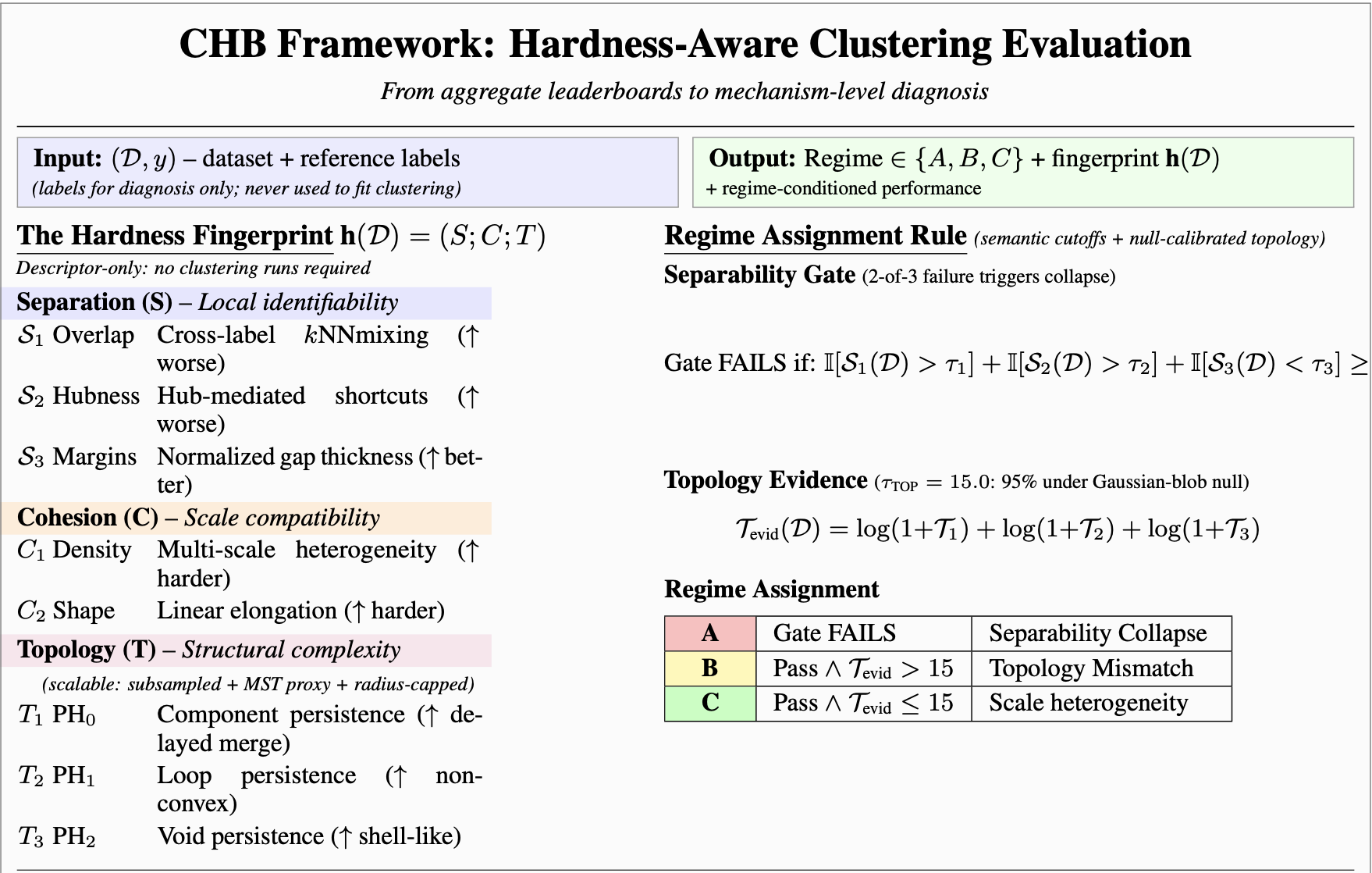 CHB: A Diagnostic Toolkit for Hardness-Aware Clustering EvaluationWalid Durani, Philipp Jahn, Collin Leiber, David B. Hoffmann, Thomas Seidl, Claudia Plant, and Christian BöhmApr 2026
Clustering is commonly compared through leaderboards that collapse performance into a single aggregate ranking. Such summaries obscure why methods succeed, which data properties align with failure, and how conclusions shift under representation changes and realistic tuning constraints. We present CHB, a diagnostic toolkit for hardness-aware clustering evaluation. CHB maps each dataset–representation pair to an interpretable hardness fingerprint capturing (i) separation, (ii) cohesion and scale heterogeneity, and (iii) topology through scalable persistent-homology summaries. Using this diagnostic space, CHB evaluates clustering algorithms under standardized, compute-aware tracks. Conditioning results on hardness coordinates turns comparison into diagnosis: across a broad range of datasets and their representations, CHB reveals reproducible structural regimes, uncovers regime-dependent ranking reversals across method families, and surfaces robustness signatures, including topology-linked breakdowns. CHB further enables representation auditing by attributing gains to measurable shifts in the hardness fingerprint rather than just external performance changes. We release CHB as an open, extensible artifact for evaluating new clustering methods and embeddings within a shared diagnostic framework.
@misc{durani2026_chb,
  title = {CHB: A Diagnostic Toolkit for Hardness-Aware Clustering Evaluation},
  author = {Durani, Walid and Jahn, Philipp and Leiber, Collin and Hoffmann, David B. and Seidl, Thomas and Plant, Claudia and Böhm, Christian},
  year = {2026},
  month = apr,
  day = {30},
  url = {https://icml.cc/virtual/2026/poster/65800},
}
2025
- arXiv
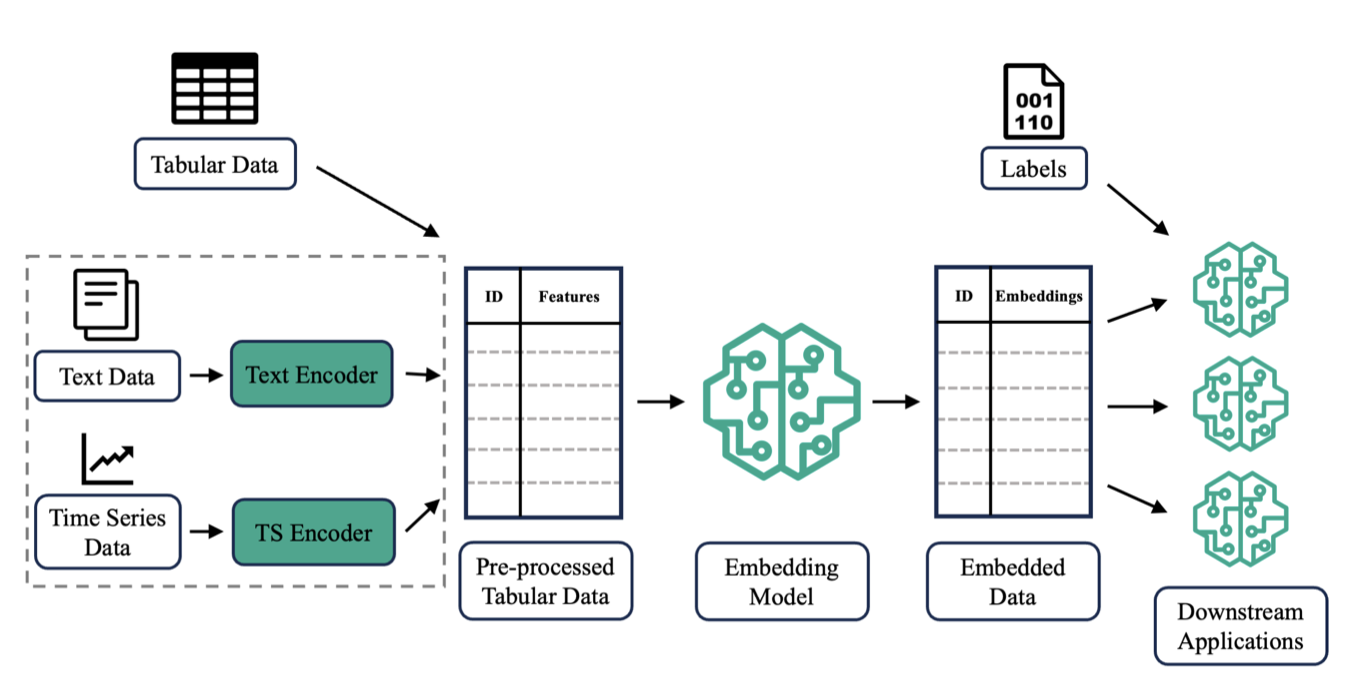 Autoencoder-based General Purpose Representation Learning for Customer EmbeddingJan Henrik Bertrand, David B. Hoffmann, Jacopo Pio Gargano, Laurent Mombaerts, and Jonathan TawsFeb 2025
Recent advances in representation learning have successfully leveraged the underlying domain-specific structure of data across various fields. However, representing diverse and complex entities stored in tabular format within a latent space remains challenging. In this paper, we introduce DEEPCAE, a novel method for calculating the regularization term for multi-layer contractive autoencoders (CAEs). Additionally, we formalize a general-purpose entity embedding framework and use it to empirically show that DEEPCAE outperforms all other tested autoencoder variants in both reconstruction performance and downstream prediction performance. Notably, when compared to a stacked CAE across 13 datasets, DEEPCAE achieves a 34% improvement in reconstruction error.
@misc{bertrand2025_deepcae,
  title = {Autoencoder-based General Purpose Representation Learning for Customer Embedding},
  author = {Bertrand, Jan Henrik and Hoffmann, David B. and Gargano, Jacopo Pio and Mombaerts, Laurent and Taws, Jonathan},
  year = {2025},
  month = feb,
  day = {28},
  eprint = {2402.18164},
  archiveprefix = {arXiv},
  primaryclass = {cs.LG},
  url = {https://arxiv.org/abs/2402.18164},
}
2024
- arXiv
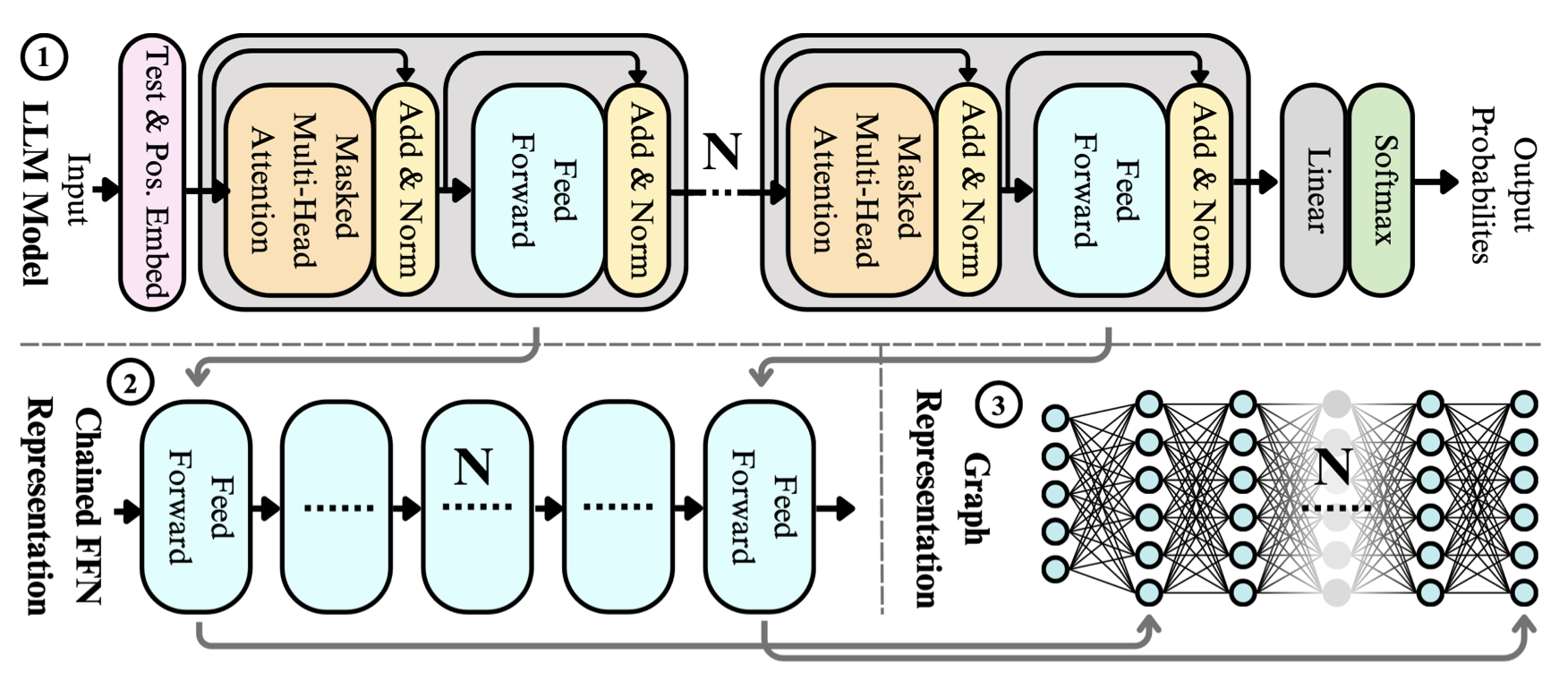 LLM-Rank: A Graph Theoretical Approach to Pruning Large Language ModelsDavid B. Hoffmann, Kailash Budhathoki, and Matthaeus KleindessnerOct 2024
The evolving capabilities of large language models are accompanied by growing sizes and deployment costs, necessitating effective inference optimisation techniques. We propose a novel pruning method utilising centrality measures from graph theory, reducing both the computational requirements and the memory footprint of these models. Specifically, we devise a method for creating a weighted directed acyclical graph representation of multilayer perceptrons to which we apply a modified version of the weighted PageRank centrality measure to compute node importance scores. In combination with uniform pruning this leads to structured sparsity. We call this pruning method MLPRank. Furthermore we introduce an extension to decoder-only transformer models and call it LLMRank. For both variants we demonstrate a strong performance. With MLPRank on average leading to 6.09 % higher accuracy retention than three popular baselines and 13.42 % with LLMRank compared to two popular baselines. Code is available at https://github.com/amazon-science/llm-rank-pruning.
@misc{hoffmann2024_llmrank,
  title = {LLM-Rank: A Graph Theoretical Approach to Pruning Large Language Models},
  author = {Hoffmann, David B. and Budhathoki, Kailash and Kleindessner, Matthaeus},
  year = {2024},
  month = oct,
  day = {14},
  eprint = {2410.13299},
  archiveprefix = {arXiv},
  primaryclass = {cs.LG},
  url = {https://arxiv.org/abs/2410.13299},
}
2023
- arXiv
 Impact of HPO on AutoML Forecasting EnsemblesDavid B. HoffmannNov 2023
A forecasting ensemble consisting of a diverse range of estimators for both local and global univariate forecasting, in particular MQ-CNN,DeepAR, Prophet, NPTS, ARIMA and ETS, can be used to make forecasts for a variety of problems. This paper delves into the aspect of adding different hyperparameter optimization strategies to the deep learning models in such a setup (DeepAR and MQ-CNN), exploring the trade-off between added training cost and the increase in accuracy for different configurations. It shows that in such a setup, adding hyperparameter optimization can lead to performance improvements, with the final setup having a 9.9 % percent accuracy improvement with respect to the avg-wQL over the baseline ensemble without HPO, accompanied by a 65.8 % increase in end-to-end ensemble latency. This improvement is based on an empirical analysis of combining the ensemble pipeline with different tuning strategies, namely Bayesian Optimisation and Hyperband and different configurations of those strategies. In the final configuration, the proposed combination of ensemble learning and HPO outperforms the state of the art commercial AutoML forecasting solution, Amazon Forecast, with a 3.5 % lower error and 16.0 % lower end-to-end ensemble latency.
@misc{hoffmann2023_automl_forecasting,
  title = {Impact of HPO on AutoML Forecasting Ensembles},
  author = {Hoffmann, David B.},
  year = {2023},
  month = nov,
  day = {7},
  eprint = {2311.04034},
  archiveprefix = {arXiv},
  primaryclass = {cs.LG},
  url = {https://arxiv.org/abs/2311.04034},
}